
Cloning of gRNAs into pLENTICRISPRv2-GFP plasmid
Aim: To generate pLENTICRISPRv2-GFP plasmids containing sgRNAs of interest for CRISPR Cas9 mediated knock out of a gene of interest.
Method:
- For this protocol we will use the plasmid pLENTICRISPRv2-GFP
- This plasmid was modified to express GFP by the Feldser lab using a plasmid originally from the Feng Zhang lab which is available to purchase from addgene (https://www.addgene.org/82416/)
- This plasmid is useful as it will contain the sgRNA of interest, cas9 and a GFP marker all in one plasmid
- When transfected into HEK293T cells along with packaging and envelope coding plasmids (psPax2 and pMD2.G), lentiviral particles will be produced to transduce hard to transfect cell lines
- The gRNA sequence can be designed with an online program or sgRNAs can be used from previously published sequences.
- For use in the pLENTICRISPRv2-GFP plasmid add CACCG to the 5’ end of the forward primer and then create a compliment of the gRNA sequence and add on a C to the beginning and CAAA to the end. Then do a reverse to obtain the oligo to be ordered
- This is so the annealed oligos can be ligated into the linearized pLENTICRISPRv2-GFP plasmid (digested with Esp3i enzyme (also known as BsmBi enzyme), ThermoFisher Scientific # FD0454). As shown below
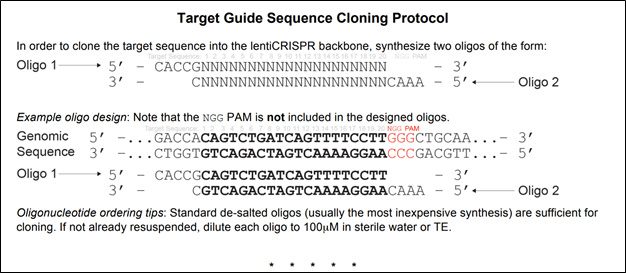
Figure 1. Taken from Zhang lab protocol for construction of pLENTICRISPR plasmids
media.addgene.org/data/plasmids/52/52961/52961-attachment_B3xTwla0bkYD.pdf
- For example the below oligos were ordered to knockout mouse PD-L1
| Gene name | gRNA sequence | Oligonucleotide sequence | PMID |
| CD274 / PD-L1 Forward | AATCAACCAGAGAATTTCCG | CACCGAATCAACCAGAGAATTTCCG | 28723893 |
| CD274 / PD-L1 Reverse | TTAGTTGGTCTCTTAAAGGC | AAACCGGAAATTCTCTGGTTGATTC |
- I order oligos dry from ThermoFisher scientific and then reconstitute in nuclease free water at 100 µM
- The below annealing and ligation protocols were adapted for this plasmid from researcher Dr Abdullah Khan, University of Birmingham (@abattacks). Thanks Ab!
Annealing of oligos
- First you need to anneal the oligonucleotides, this can be done without phosphorylation
- In a PCR tube assemble the following:
Oligo 1 Forward (100 µM) 2 µL
Oligo 2 Reverse (100 µM) 2 µL
5 x Ligase buffer (T4 cat no# 15224017) 4 µL
Nuclease free water 12 µL
TOTAL 20 µL
Then heated to 95ºC for 5mins and then turn off the PCR machine or heat block to allow the samples to cool down gradually with the tubes inside
Digestion and ligation one step reaction
If you trust your pipettes to manage these small quantities go ahead, if not just double up on all the quantities.
pLENTICRISPRv2-GFP 0.5 µL (25 ng)
Annealed oligos (1:1 dilution) 0.5 µL
Esp3i (BsmBi) (Thermo, cat no. FD0454) 0.25 µL
Fast digest buffer 10x 0.5 µL
T4 ligase (Thermo, cat no. 15224017) 0.25 µL
DTT 20 mM 0.25 µL
Nuclease free water 2.75 µL
TOTAL 5 µL
Incubate at 37 ºC for 2 hours and then transform 2 µL into Stabl3 competent E.coli (I used home made competent cells, but can be bought from ThermoFisher Scientific).
I also included negative controls with all the above components but no oligos.
I got plenty of colonies and 24 out of 25 were correct by colony PCR. So I just sequenced 1 clone each construct and the large majority were the correct clone.
Notes:
- For sequencing of this vector I used the below forward primer
- TACGTGACGTAGAAAGTA
- For colony PCR to ID clones with an inserted gRNA I used the above forward sequencing primer and also the reverse cloning primer of each construct.
 alifeofscienceblog.com